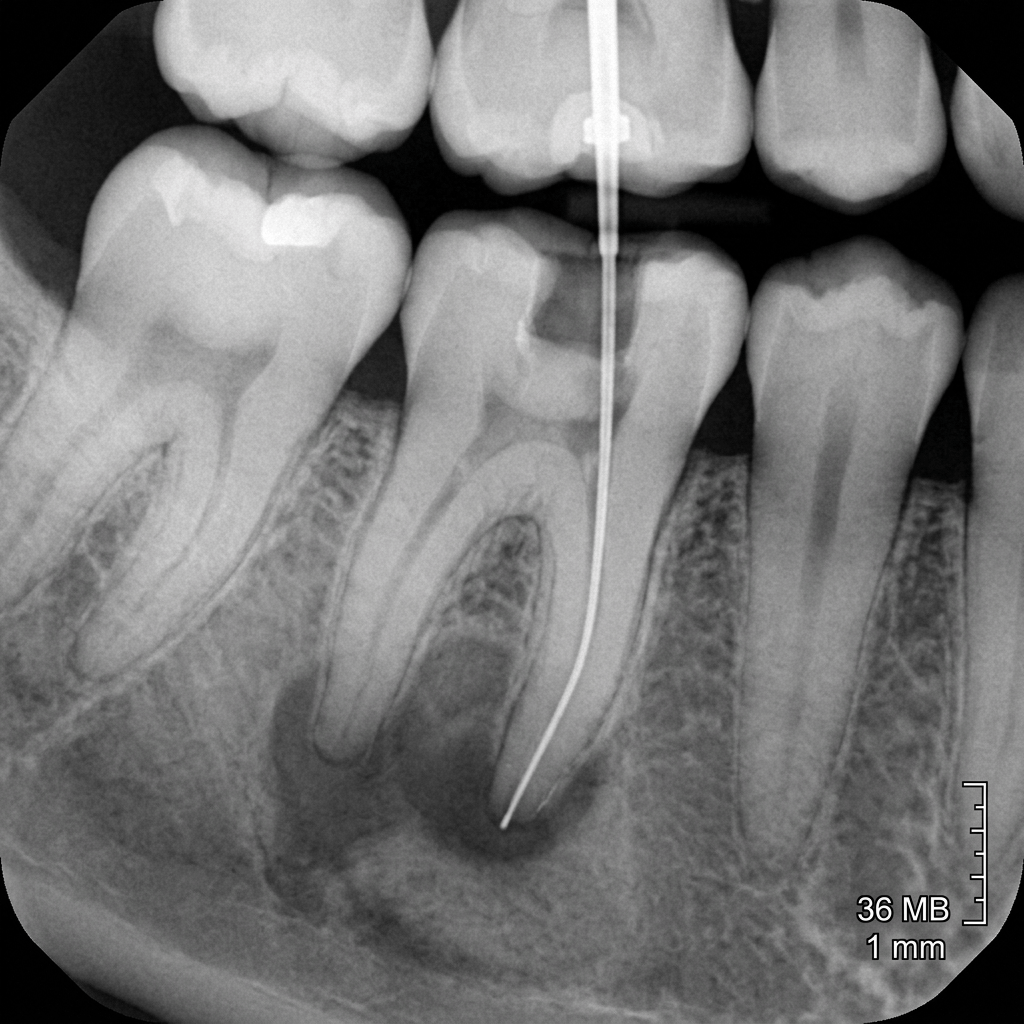
Working length is one of the most important measurements in root canal treatment because it determines how far instrumentation and obturation extend within the root canal system. Accurate working-length determination allows the clinician to adequately clean and disinfect the canal while minimizing unnecessary instrumentation into the periapical tissues. If the working length is too short, portions of the infected canal may remain untreated, potentially allowing microorganisms to persist and compromising periapical healing. Conversely, extending instrumentation beyond the desired working length can unnecessarily traumatize the periapical tissues. Accurate working-length determination is therefore essential for effective root canal preparation and obturation. Electronic apex locators (EALs) and radiographs are commonly used to determine or verify working length during root canal treatment. This raises an important clinical question: Does using an electronic apex locator compared with radiographic determination of working length affect the quality or outcome of root canal treatment?
A study by Fouad and Reid published in 2000 evaluated the effect of using an electronic apex locator compared with radiographic determination of working length on selected endodontic treatment parameters. The investigators found a significantly higher number of acceptable cases in the group in which an EAL was used compared with the radiographic group. Acceptable cases were defined as obturation extending to within 0–2 mm of the radiographic apex. Additionally, a higher percentage of cases in the EAL group were within 1 mm of the final working length compared with the radiographic group. These findings suggest that EAL use may improve the clinician’s ability to establish a working length that more closely corresponds with the desired apical endpoint. More accurate working-length determination may subsequently allow for more precise canal preparation and obturation.1
However, other clinical evidence suggests that the difference between EALs and radiographs may not be as substantial when evaluating the final working length and obturation. A randomized controlled trial by Ravanshad, Adl, and Anvar in 2010 compared radiographic determination with the Raypex5 electronic apex locator for determining working length, master cone position, and final obturation. The study found no significant difference between the groups in the number of acceptable working lengths or in the final obturation. These findings suggest that, under clinical conditions, both radiographic and EAL methods can produce comparable working-length and obturation results.3
Evidence from in vitro and histologic studies also supports the accuracy of electronic apex locators. Pratten and McDonald evaluated electronic and radiographic working-length measurements using extracted teeth and histologic examination to determine the location of the apical constriction. The authors found that electronic measurements had a significantly smaller deviation from the histologically determined apical constriction compared with radiographic measurements. This supports the ability of EALs to provide a more accurate estimate of the apical endpoint, particularly because radiographs cannot directly identify the three-dimensional location of the apical constriction.2
When considering the findings from these studies collectively, electronic apex locators appear to provide an accurate method for determining working length and may offer greater precision than radiographic measurements in certain circumstances. However, the available evidence does not demonstrate that EAL use alone necessarily results in superior long-term treatment outcomes. Rather, EALs and radiographs should be viewed as complementary tools. Electronic apex locators provide valuable information regarding the location of the apical endpoint, while radiographs provide anatomical information that cannot be obtained from an EAL alone, including root morphology, canal curvature, and the relationship of the root to surrounding structures. Therefore, combining EAL measurements with radiographic assessment may provide the clinician with the most comprehensive approach to working-length determination.
Resources:
- Fouad A, Reid L. Effect of Using Electronic Apex Locators on Selected Endodontic Treatment Parameters. Journal of Endodontics, 26, 364-367
- Pratten D, McDonald N. Comparison of radiographic and electronic working lengths. Journal of Endodontics, 22, 173-176
- Ravanshad S, Adl A, Anvar J. Effect of Working Length Measurement by Electronic Apex Locator or Radiography on the Adequacy of Final Working Length: A Randomized Clinical Trial. Journal of Endodontics, 2010; 36, 1753-1756

