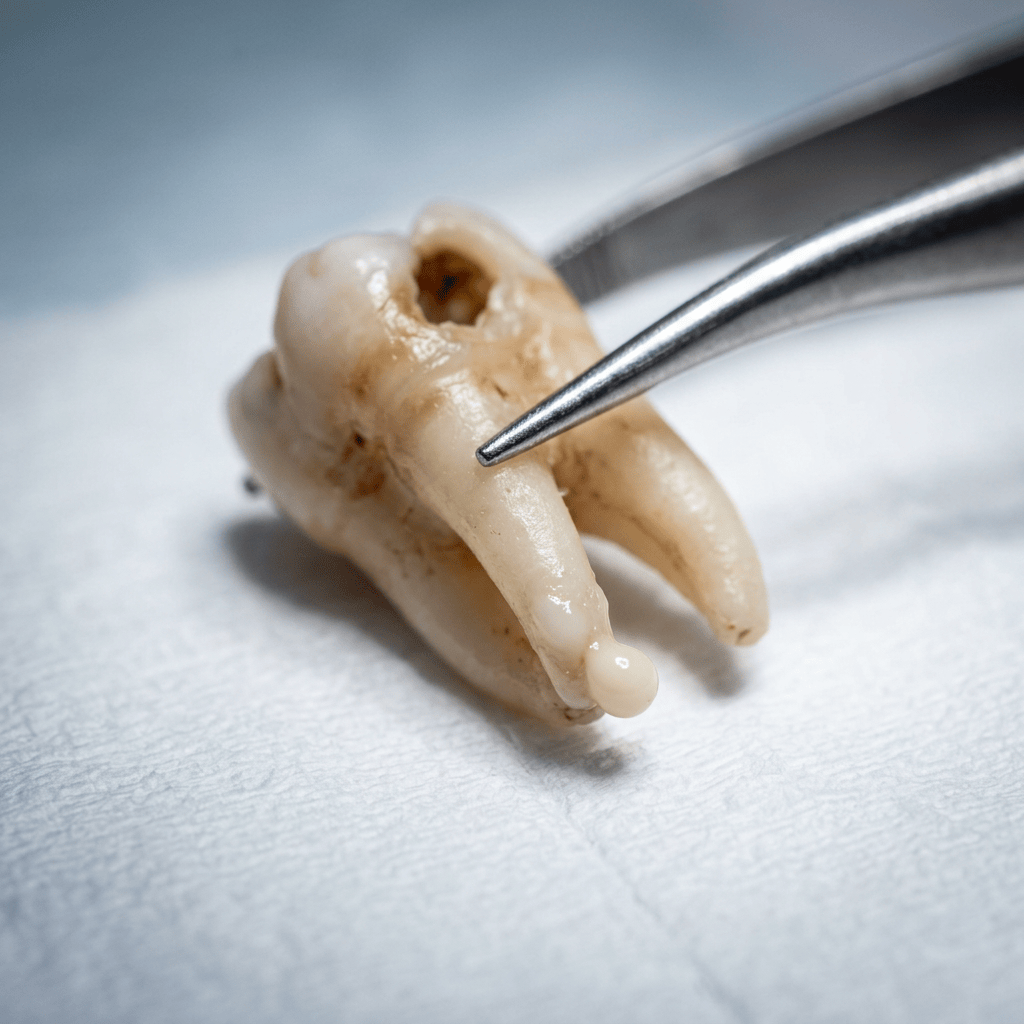
During root canal treatment, a small amount of root canal sealer was unintentionally extruded into the periapical tissues during obturation. This case raises important clinical questions: Does apical extrusion of root canal sealer alter the outcome of endodontic treatment? Does extruded material contribute to postoperative pain, persistent inflammation, or impaired periapical healing? Can favorable healing still occur despite sealer extending beyond the root apex? This review examines the available evidence surrounding apically extruded root canal sealers, focusing on their clinical consequences and influence on long-term treatment outcomes.
Root canal sealer is used to fill microscopic spaces between gutta-percha and the canal walls. Its primary purpose is to improve the seal of the root canal system by filling irregularities that cannot be adequately occupied by gutta-percha alone, helping to limit the persistence or penetration of microorganisms.
A retrospective study published in 2023 reviewed treatment outcomes between two groups: one group had no radiographic evidence of sealer extrusion beyond the apex during nonsurgical root canal treatment, while the other had AH Plus sealer extending beyond the apex into the periapical tissues. Clinical and radiographic evaluations were performed at a one-year follow-up, with outcomes categorized as healed/healing or uncertain/non-healing. The study found no statistically significant difference in favorable outcomes between the two groups.3
Similarly, a retrospective study published in 2015 investigated the same question in teeth obturated by a single provider. Treatments with radiographic evidence of sealer extending beyond the apex were compared with those without extrusion. Evaluations were performed at 1, 2, and 4-year follow-ups, and no significant difference in treatment outcomes was found between teeth with and without extruded sealer. The study also found no significant difference in treatment outcomes among teeth treated with AH Plus, Apexit, or Endomethasone. These findings suggest that the presence of extruded sealer does not necessarily compromise the long-term outcome of endodontic treatment.4
A 2025 multicenter randomized clinical study evaluated postoperative pain at 24 hours following treatment with NeoSealer Flo, a calcium silicate–based bioceramic sealer, and AH Plus, an epoxy resin–based sealer. NeoSealer Flo was associated with a higher incidence of sealer extrusion; however, patients with extrusion of AH Plus experienced a significantly higher incidence and level of postoperative pain. These findings suggest that the relationship between sealer extrusion and postoperative pain may depend partly on the type of sealer used.1
The incidence of sealer extrusion can potentially be reduced through careful clinical technique and an understanding of factors that increase the likelihood of extrusion. A study published in 2026 found that the likelihood of sealer extrusion significantly increased in wet canals, larger apical diameters, and with pumping actions during sealer placement. These findings highlight several factors that clinicians can control during obturation to minimize unnecessary extrusion.2
Overall, the current evidence suggests that unintentional apical extrusion of root canal sealer does not necessarily indicate an unfavorable treatment outcome. While extrusion may be associated with increased short-term postoperative pain in certain circumstances, particularly depending on the type of sealer used, current studies have not demonstrated a significant negative effect on long-term periapical healing. Clinicians should therefore aim to minimize unnecessary extrusion through careful working length determination, appropriate sealer placement, and controlled obturation technique. Using an appropriate amount of sealer, avoiding excessive pumping or pressure during placement, and maintaining adequate apical control can help reduce the risk of forcing sealer beyond the apical foramen. Nevertheless, the presence of a small amount of extruded sealer alone should not be considered a reason to assume treatment failure.
Resources:
- Ensinas P, Aranguren J, Tosco V …
The Impact of Calcium Silicate–Based and Resin-Based Root Canal Sealers on Postoperative Pain and Sealer Extrusion: A Multicenter Randomized Clinical Study
Journal of Endodontics, 2025; 51, 1508-1518 - Iqbal S, Adams N, Camilleri J
Factors Influencing Apical Extrusion of 2 Types of Endodontic Sealers with Different Delivery Systems
Journal of Endodontics, 2026; 52, 806-811 - Martins J, Scheeren B, van der Waal S
The Effect of Unintentional AH-Plus Sealer Extrusion on Resolution of Apical Periodontitis After Root Canal Treatment and Retreatment—A Retrospective Case-control Study
Journal of Endodontics, 2023; 49, 1262-1268 - Ricucci D, Rôças I, Alves F …
Apically Extruded Sealers: Fate and Influence on Treatment Outcome
Journal of Endodontics, 2015; 42, 243-249

